Sunday, March 16, 2014
100 People Who Made History by Ben Gilliland
I loved this book! It's filled with so many fascinating people. There were many that I recognized: Marco Polo, Charles Darwin, Thomas Edison, Aristotle, Joan of Arc, Walt Disney, and Elvis Presley, to name a few. Even though these names were familiar I didn't know everything the book had to say about them. There were also many people that I didn't recognize: Dmitri Mendeleev (created the first version of the Periodic Table), Cai Lun (invented paper), Mary Seacole (pioneering nurse), Saladin (Muslim leader who retook the Holy Land), David Ogilvy (the father of modern advertising). I found each and every one of them interesting.
The book is divided into categories: Daring Discoverers, Inspirational Inventors, Thoughtful Thinkers, Leading Leaders, and Clued-up Creatives. The author presented the information in a couple of different formats. Some people took up one page, some 2 pages, while others were condensed so that several appeared on one page.
One of my favourite parts if the "All About Me" section, which features year of birth and death, nationality, interesting factoid (claim to fame), and a brief summary. I liked it because it gave me a brief snapshot of the person before I read more about them. This was particularly helpful for those I was unfamiliar with. I would have liked it if the author included this information for each of the figures in the book. Unfortunately, that didn't happened.
The other two parts that I enjoyed were "He couldn't have done it without...", which showed the person's forefathers and their contributions, and "He paved the way for...", which showed those who came after him in his field. These people benefitted from the work that had already been done. I liked these two sections because it gave me some perspective on the person's work and put it into context.
I also liked that the book contained some more modern figures like, Jobs and Wozniak, Zuckerberg, and Nelson Mandela. Having said that, I enjoyed reading about all of the figures in the book, both historical and more contemporary.
Two pages at the back of the book are dedicated to more people who have made contributions, but didn't quite make the top 100 list. These include: Noah Webster, Sacajawea, Helen Keller, Tommy Douglas, Gloria Steinem, Terry Fox, and many others.
The book also includes a table of contents, a glossary, and an index.
Highly recommended. It's written for younger readers (7-12 year olds), but older readers might also enjoyed this one provided they don't need a lot of information on each person.
For more information about this book or to browse inside, please visit DK's website.
I'd like to thank Chris at DK Canada for this review copy.
100 People Who Made History by Ben Gulliland, Dorling Kindersley (DK), ©2012. ISBN 9780756690038(Hardcover), 128p.
Friday, August 30, 2013
Back to School with DK - How to be a Math Genius by Mike Goldsmith
Need to know more about English, math, science or history or another subject? DK probably has a book for you. Whether your child is taking his or her first steps to school or entering their final year, these books can start the school year off right. By the way, many of these books aren't just for kids. Even adults can learn a thing or two.
Click here or on the icon to the left to see the list of books in the Back to School Boutique.
Today, I have a review of one of those books.
How to be a Math Genius talks about the brain and math while using games, logic problems, puzzles, and activities to boost your brain power.
This is such a fun book! It's very similar to How to be a Genius also by DK Publishing (my review), but this book focuses on how your brain tackles math. Therefore, the brain games are math related.
The book features terrific illustrations that are bright and exciting. It's filled with interesting facts about the brain and uses some fun exercises (labelled "Brain Games") to explain a point and emphasize the information that's presented. The main things I loved about this book is that it made math accessible and showed how much of our daily lives revolve around math. There's mapping, probabilities, sequences, patterns, measurements, shapes, codes and ciphers...it goes on and on. There's even a little history thrown in.
All of the brain games were fun, but many of them were challenging. However, math isn't my best subject. It's written for 10-14 year-olds and I think kids will love this book. I think adults, like me, might enjoy this book, too. However, those poor in math might be discouraged and find the puzzles and games too hard. I love that the book has some tips on how to be better at math. I sure could use these. Regardless, it's filled with amazing information and facts about the brain and math.
One of my favourite pages is about the Big zero (page 30-31). It talks about how important 0 is. Who knew that nothing was something? ;)
The book also features many famous math geniuses. These include: Pythagoras, Archimedes, Karl Gauss, Leonhard Euler, Isaac Newton, and Alan Turing. I had heard of some of these people, but not all of them. The information presented was interesting nevertheless. I found the two-page spread of historical women, who broke into the mostly-male-dominated field of math, particularly interesting.
The table of contents lists the major sections and topics within each of those sections. The back of the book contains a glossary, index, and answers to the brain games.
Highly recommended.
For more information about this book or to browse inside, please visit DK's website.
I'd like to thank Chris at DK Canada for this review copy.
How to be a Math Genius by Mike Goldsmith, Dorling Kindersley (DK), ©2012. ISBN 9780756697969(Hardcover), 128p.
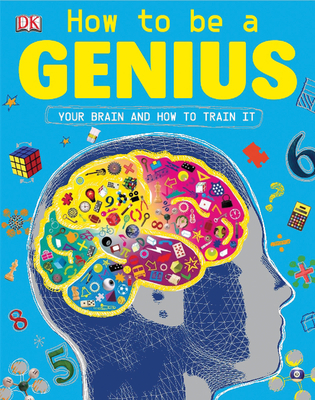
Back to School with DK - How to be a Genius by John Woodward
Need to know more about English, math, science or history or another subject? DK probably has a book for you. Whether your child is taking his or her first steps to school or entering their final year, these books can start the school year off right. By the way, many of these books aren't just for kids. Even adults can learn a thing or two.
Click here or on the icon to the left to see the list of books in the Back to School Boutique.
Today, I have a review of one of those books.
How to be a Genius explains how the brain works and presents lots of puzzles, games and optical illusions to exercise and train your way to being a genius.
I loved this book. It's wonderfully illustrated with bright and exciting colours. It's filled with interesting facts about the brain and uses some fun exercises (labelled "Brain Games") to explain a point and emphasize the information that's presented. I particularly liked how the section on the parts of the brain and how it works with the rest of the body. I also liked the games and puzzles as they are intended to get your mind working. The book is written for 10-17 year olds, but older kids (aka adults) might also find this book useful and/or interesting.
There's also little tidbits of interesting information scattered throughout the book. Here are two examples: "There is a theory that it takes 10,000 hours of work to be an expert at anything - that's around ten years of practice" (page 20) and "The six basic facial expressions of emotion are the same in all human cultures worldwide" (page 158).
The book also has pages featuring many famous geniuses. These include: Mozart, Einstein, da Vinci, Gandhi, Darwin and a few others I hadn't heard of like Wernher von Braun (a rocket scientist), Jean Francois Champollion (master of languages, decoded the hieroglyphs on the Rosetta Stone), Mary Anning (pioneer in geology), and George Washington Carver (fought racism and improved the lives of the poor by focusing on agriculture). I actually had heard of Carver, but I didn't know what he did. All of these features were extremely interesting.
All of the brain games were fun, but many of them were challenging, at least for me anyway. A genius I am not. I think kids will like them. It was especially amusing to read the pages for training your pet (page 178-179, follows the pages on animal intelligence). Even though I don't have any pets, I loved learning how to train the various pets; dog, cat, hamster, guinea pig and goldfish.
The table of contents lists the major sections and topics within each of those sections. The back of the book contains a glossary, which includes some fascinating definitions as well as an adequate index. Of course, there are several pages of answers to the brain games.
Highly recommended.
For more information about this book or to browse inside, please visit DK's website.
I'd like to thank Chris at DK Canada for this review copy.
How To Be a Genius by John Woodward, Dorling Kindersley (DK), ©2099. ISBN 9780756655150(Hardcover), 192p.
Monday, March 18, 2013
This Book Made Me Do It by DK Publishing
DK is celebrating Spring Break with its "Time to Play" promotion. This week I'll be featuring three books from their Time to Play boutique. If spring break has already passed in your area, these books can be used for family time or other times when the kids need something to do. Click here or on the photo on the left to see some other books.
This Book Made Me Do It is filled with activities, crafts and how-tos for the whole family. Whether it's baking a cake, learning to knit, nailing a free throw, or learning how to use your watch to find your way, this book shows you how to do it.
I love this book! It's great that the authors chose to include activities from so many different areas and ones of varying degrees of length and difficulty. It's geared towards 10-17 year-olds, but I think the younger ones in this range will get the most out of it. Who can tell with teenagers?
The book is divided into sections. The groupings are ok, but some of them seem pretty arbitrary. The "Amaze Your Friends" chapter, features activities that involve magic, dance, astrology, even landing a plane! The "Exploring the World" chapter features stuff like finding constellations, growing crystals, sprouting a bean, and panning for gold. The "Survive in the Wild" section includes activities like making a compass, cooking, fishing, lighting a campfire, plus a lot of other stuff you hope you'll never have to use, like surviving an avalanche and first aid. Other sections include a food section, a creative/crafty section and a sports section; all pretty self explanatory.
I'm just amazed at the variety of activities. Some take specialized equipment, others no or very little equipment at all. Some are quick and easy, others are more involved. There are others that are quite practical, while others are whimsical. It's all very cool. Of course, there are some things you probably won't be able to do or try out (land a plane, climb Mount Everest), but it's fun to learn about the steps you'd have to take in order to do so.
For the purposes of this review, I decided to do a couple of the activities. The two that I chose: make origami animals (page 72) and cook for birds (page 98). Overall, it was a lot of fun. However, the origami instructions were a little confusing and the bird food didn't have amounts. See below for more photos and details. I'll probably be doing a few more of the activities if spring and summer ever get here. These include: making a weathervane (page 108) and planting some sunflower seeds (page 101).
Other than the small complaints above, I found that a few of the pages were hard to read, especially those printed on polka dotted backgrounds, like the index. Maybe it's just my old eyes. ;)
The table of contents is extensive. It lists the section heading along with all of the activities in that section. The format could be improve a little by somehow setting the section headings apart from their contents by using a different font or font size or by using the Italics or bold typeface. The index was good, even though it was a little hard to read.
Highly recommended for the whole family.
For more information about this book, please visit DK's website.
I'd like to thank those nice people at DK Canada for this review copy.
This Book Made Me Do It by DK Publishing, Dorling Kindersley (DK) ©2010. ISBN 9780756668815(Hardcover), 192p.
My Activities
Origami Animals I previously purchased some origami paper for another craft, but hadn't gotten around to doing it. I figured this was an easy one to start with. The instructions were a little confusing, but for my first attempt I think they turned out pretty good. Here's a swan and a pig:
The pig can actually stand up, but it's a little unsteady on his feet. Because the paper is so thin, I kept blowing him over. It was just easier to lay him down.
Cook for birds I already have lots of bird feeders in my backyard, but I hadn't made any of the food myself. I had all of the ingredients so I decided to make my own suet treats. It turned out to be pretty easy. However, the activity/recipe didn't give any amounts, so I had to wing it. Also, one of the tips was to add a perch for smaller birds, but it didn't say how to do it. I tried, but it didn't turn out that great. I don't think it's sturdy enough for perching on. So far, the birds haven't been too interested in it. I did see 1 chickadee peck at it a couple of times, so there's still hope. Part of the problem is that I have lots of other food out there for them. Here are some photos:
Ingredients. I used 283 grams (10 oz) of plain suet and approximately two cups of bird food (sunflower chips, dried meal worms, shelled peanuts)
All done. Now they just have to cool. I was impatient, so I put them in the freezer for a few hours rather than leaving them to cool overnight. It seemed to work ok. Who knew that dried meal worms would float, though? If nothing else, the gross factor is high.
Feeders outside. I'm pretty sure that these would melt under the summer sun on a really warm day, so I hope to use them up before summer.
Tuesday, February 5, 2013
Danger! by DK Publishing
This is a very cool book! It's similar to other books published by DK in that each 2-page spread tackles a different subject with using eye-catching designs, colourful and interesting graphics/illustrations, as well as informative text. Even though it's written for 10-17 year-olds, I learned a lot about the dangers surrounding me. Mind you, I think I'm pretty safe from some of them (I don't plan on taking up extreme sports or going into orbit anytime soon), but it's nice to know what's lurking around the corner.
The book is grouped into chapters featuring items from nature, such as sharks; the planet, the Bermuda Triangle for example; space, wouldn't be complete without an alien encounters; science, like radioactivity; the human body, featuring epidemics and pandemics; places, such as dangerous foods and extreme sports; and dangers of the past including weapons of war. Each one of them had some pretty exciting, yet dangerous, topics.
There are many very cool pages in the book. My favourites include:
• "How to Survive a Horror Movie" (page 158-159) is hilarious.
• "Horrible Handscape" (page 116-167) describes all of the bacteria and viruses that can be picked up on your hands. Yuck!
• Typhoid Mary (page 134-135) tells the "gruesome tale" of Mary Mallon in graphic novel form.
The material is presented in an entertaining way so that it's not too scary. However, it much be a little too much for younger readers or really sensitive ones. When grouped together like this, all of the dangerous things out there could get a little overwhelming.
The table of contents lists the chapters as well as the contents of each chapter. I love being able to see at a glance what topics are covered. The index is quite extensive and should help the reader find specific items in the book.
Highly recommended.
For more information about this book or to browse inside, please visit DK's website.
I'd like to thank those nice people at DK Canada for this review copy.
Danger by DK Publishing, Dorling Kindersley (DK), ©2010. ISBN 9780756667399(Hardcover), 192p.
Sunday, December 16, 2012
Optical Illusions by DK Publishers
This is such an awesome book. It's written for pre-teens (7-12 year olds), but can be enjoyed by the whole family. Not only do you get to see some terrific illusions, you also get to learn about how they work and how your eyes and brain see them.
The book contains a few classic illusions that I've seen before, but it also has a number of new-to-me ones. I haven't seen some of the classic ones for awhile and it was nice to revisit them and learn more about them. The new-to-me ones were amazing and fun to try out and read about.
I'm a huge fan of books that come with moveable and removable pieces. I know that the removable ones can become lost or damaged, but I still like them. This book has only two pieces that can be completely removed from the book, so it should be fairly easy to keep track of them. The moveable pieces include: pop-ups, pullout tabs, and other moveable parts to help the reader enjoy the illusions. These are all pretty cool!
There's even a section at the back to build your own illusion. The instructions are pretty straightforward (if you read them correctly, which apparently I can't do) and there are no extra tools required. It really well constructed and should last a long time if it's put together (and put away) carefully. It looked pretty cool, but I couldn't get it to work, like the instructions said it would. My only guess is that I constructed it incorrectly or I'm a dunce. ;)
The cover of the book is one of my favourite parts. It's been sitting on my desk and I've been playing with it for days (ever since it arrived). It's sort of hard to explain. Even though the cover is flat, it appears to have dimension. Both the title and circles seem to pop out at the reader. I guess it's 3D, but there are no special glasses required. It's so awesome.
The whole book is well constructed with thick reinforced pages. This is especially important because of the moveable and removable parts. It should last a long time even if it's repeatedly played with. It might even last long enough to hand down to another child.
Highly recommended. This book would make a great Christmas present for a pre-teen, who can then share it with the rest of the family.
For more information about this book or to browse inside, please visit DK's website.
I'd like to thank those nice people at DK Canada for this review copy.
Optical Illusions by DK Publishers, Dorling Kindersley (DK), ©2012. ISBN 9780756691891(Hardcover), 31p.
Thursday, November 22, 2012
Doodlepedia by DK Publishing
I really enjoyed this book. While I don't generally doodle in books, I like books that allow me to do so. I love how it connects activities with facts. It makes the learning fun and just might make the information easier to remember.
The book doesn't go into much depth with any one subject. Rather it's more like a list of facts on a bunch of different subjects. Even though it's a little short on information, there's plenty of things to colour and lots of room to draw. It could provide the reader with hours of reading, drawing, doodling and colouring fun.
The order of the pages appear to be random. That is there's no apparent order to the subjects. On one page you are learning about (and drawing your own) International Space Station (ISS). On the next, you are digging for diamonds. After that, you're learning about the poles, then shapes. I really liked this! The book doesn't have to be completed in a certain order, either. The reader is free to jump around to whatever they find interesting or feel like doing at the time.
I really like the style of the drawings in the book - cute and cartoon-like. They should be very appealing to the target audience, 6-12 year-olds. The text is large and easy to read, but some of the words might be a little challenging for the youngest readers. There were some words I didn't know! Most are explained (crenellations - gaps at the tops of castle walls), but a few of them are not (plinth, which I learned was a pedestal or platform.)
The book doesn't contain a table of context, an index or even page numbers. It really doesn't need them. However, if you are looking for specific subjects to learn about, that could be a drawback.
The one other drawback is that once the book has been coloured and doodled in, it's not going to be as much fun the next time or for the next reader. Although, once it's completed it might make a nice keepsake of the child's artwork for parents or grandparents if they are into that sort of thing.
Highly recommended. It would definitely make a great Christmas present! If you wrap it up with some art supplies or even just a pencil, it'll keep them quiet while you go back to bed. ;)
There are a few other Doodlepedia books available from DK. I haven't seen them, but if they are anything like this one, they'll be terrific.
For more information about this book, please visit DK's website.
I'd like to thank those nice people at DK Canada for this review copy.
Doodlepedia by DK Publishing, Dorling Kindersley (DK), ©2012. ISBN 9780756690113(Paperback), 112p.
Monday, July 9, 2012
Crime Scene Detective by Carey Scott
When this book showed up on my doorstep, I dove in immediately. I was so excited to learn more about being a crime scene detective. Written for 8-13 year olds, this book is well presented with lots of photographs and information that is easy to understand. The cases are not overly complicated and contain fairly easy to decipher clues for younger readers.
The cases are: robbery, arson, forgery and murder. Parents or kids don't have to worry about the book being too gory. Well, I guess, it depends on how squeamish you are, but I didn't think there was anything in the book to get grossed out over.
Besides the four cases to solve, the book contains lots of do-it-yourself activities, like revealing fingerprints, testing chemical characteristics, making a cast of your shoeprint, revealing secret messages and others. All of these have instructions on how to do it with commonly found items. While it isn't exactly how real crime scene investigators perform these tasks, I think the activities will give the reader a better understanding of the science and procedures behind it all.
There are a few warnings regarding safety at the beginning of the book. Parents and children should heed them.
The only trouble I had is that I misplaced my magnifying glass and had trouble clearly seeing the fingerprints. These old eyes don't see as well as they used to. ;)
The book also contains a table of contents, a glossary and an index. All of them are adequate for this type of book.
Highly recommended for budding police officers, criminalists and those who want to know more about the forensic sciences.
For more information about this book, please visit DK's website.
I'd like to thank Chris at DK Canada for this review copy.
Crime Scene Detective by by Author, DK (Dorling Kindersley), ©2007. ISBN 9780756651558(Paperback), 72p.
Tuesday, July 26, 2011
Big Questions by DK Publishing
This book is awesome! I really enjoyed reading it. It wasn't quite what I expected, though. I knew it was going to be tackling some big questions that kids have, but I was thinking more along the lines of "Why do elephants have wrinkled knees?", "Why does the sky change colour?", "Why are my eyes blue?", "How are girls and boys different?". Stuff, like that. However, this book asks even bigger questions and is much more philosophical and analytical than I thought it was going to be.
Questions include:
- What is reality?
- What is beauty?
- What is love?
- What is art/music?
- How do colors make you feel?
- What is imagination?
- Is there a god?
- Does where I'm born make me who I am?
- Can you step in the same river twice?
and many, many more!
Each question (or series of related questions) and answer is written in easy to understand language and is presented on a two-page spread, which makes it easy and fun to read. I loved that the book contains some questions that I hadn't even thought of. Maybe kids are more sophisticated than I was when I was younger; I was amazed at some of the questions that are asked and answered.
I found one question, "So, who wears the pants?" (page 54-55), to be a little odd. The answer/content is quite good and explains the roles of men and women in different cultures. However, I'm thinking that the question is outdated. While it might have been appropriate a generation or two ago, kids today might not even know what this means. If kids did have questions about gender roles, I don't think they'd ask the question in this way.
There are many really good questions and answers in the book, but one of my favourites was the question "Where do phobias come from?" (page 78-79). It was really interesting. I enjoyed learning the names of the different phobias, many of which I didn't know. For example, alektorophobia = fear of birds, chronomentrophobia = fear of time.
The illustrations in the book are quite cute and very colourful. I love all of the little characters and can imagine that many of them will find their way into kids' doodles on notebooks, desks and whatnot!
The book also contains a table of contents, glossary and index. All of these are pretty good.
Highly recommended. Even though the book is geared towards kids, it definitely got me thinking.
For more information about this book or to browse inside, please visit DK's website.
I'd like to thank Chris at DK Canada for this review copy.
Big Questions by DK Publishing, Dorling Kindersley (DK), ©2011. ISBN 9780756675790(Hardcover), 128p.
Monday, January 17, 2011
Children's Book of Music by DK Publishing
Children's Book of Music presents an introduction to music by featuring musicians, instruments, musical styles and performances. Using large photographs and descriptive text, the book takes young (and old) readers on a tour from ancient world music to today's new sounds.
This is a terrific book. The page layouts are wonderful. They feature large photographs and illustrations as well as easy to understand text. I especially love that the book doesn't centre around one part of the world or one genre of music. I also love that it's presented chronologically. The four different types of pages in the book allow the authors to include different parts of the music world. These pages are: musician profiles, music styles, performance, instrument profiles.
The musician profile pages have sidebars that feature timelines and musical influences. These are great. I love learning about the person behind the sound.
The music style pages offer details about all kinds of music. It was great to see about how the various styles developed. My favourite pages are the ones I know virtually nothing about: reggae, hip-hop and the blues. While none of these genres is my favourite, I appreciate the information on how the music evolved into these forms. It's really quite interesting.
The performance pages feature a variety of things: groups of instruments, musical gatherings, types of performances and more. I love reading about all of the operas and great conductors.
The instrument profiles pages feature stunning photographs that are well labelled. Well, most of them anyway. The pages have timelines, range of notes played as well as numerous other tidbits of information. It was nice to learn about the different parts of the instruments. One of my favourites is the profile on the sitar, tabla and tambura (page 32-33). While it doesn't feature large labelled photographs, the information is very interesting. Another favourite is definitely the Map of the Orchestra (page 52-53). I've been to the symphony many, many times, but I never get tired of seeing all of the instruments.
As I flipped through the book, I found lots of interesting facts about music and its makers. Here are some of my favourites:
- J.S. Bach had 20 children. (page 40)
- Wagner was Hitler's favourite musician. (page 61)
- Frank Sinatra learned "a sneaky sideways circular breathing technique so he could hold a note for ages". (page 103).
- Elvis's natural hair colour was sandy blonde. (page 105) (Can you imagine a blonde Elvis?)
- Jimi Hendrix was left-handed, but played a right-handed guitar, which he held upside down. (page 113)
My favourite quote comes from Claude Debussy:
It is unnecessary for music to make people think...It would be enough if it made them listen. (page 80)
The accompanying 1 hour-long CD has 35 tracks of world music in varying styles. The book instructs the reader when to listen to each of the tracks. For example, there's an instrument profile on the didgeridoo on pages 16-17. The instructions say:
Listen to Track 2. Find two sticks to wooden spoons and join in the tapping rhythm of the clapsticks accompanying this piece of didgeridoo music.I think that's one of the coolest parts of the book. Even though the tracks are just snippets of the original work, the CD makes a fantastic accompaniment to the book. The design of the CD sleeve is superb. Even though it's plastic and tends to be a bit sticky, the large flap makes it very easy to remove and replace the CD.
The table of contents in the book is nicely laid out into sections. The glossary is also nicely laid out with clear, concise definitions for terms used in music. Unfortunately, the book does not have an all-encompassing index. Not so handy when you want to look up trumpet, for example. It does, however, have a rather extensive "Index of Musicians".
Highly recommended. This book is for children ages 7-17. Despite being quite a bit older than that, I really enjoyed it. I bet most adults would learn something new from this book. Unless of course that adult happens to have a major in music and has studied world music history. Even then, you never know.
For more information about this book or to browse inside, please visit DK Canada's website.
I'd like to thank Chris at DK Canada for this review copy.
Children's Book of Music by DK Publishing, Dorling Kindersley (DK), ©2010. ISBN 9780756667344(Hardcover), 142p.
Monday, April 16, 2007
Crime in the Cards (The Hardy Boys #165) by Franklin W. Dixon
This is another pretty good mystery featuring the Hardy Boys. I still prefer Nancy Drew, but these ones are almost as entertaining. Although, I enjoyed the story, I couldn’t relate to the fantasy game these kids were playing. I’m not into that sort of thing; never have been. The story contains some wacky characters and is fun to read.
Recommended for younger readers.